Apple now has one set of business terms for every app sold in the European Union, and it has been in force since 1 October 2026. If your business has an iPhone app that sells anything digital to customers in Europe, the cut Apple takes may have changed six weeks ago without anyone telling you.
Introduction
Apple announced the change on 18 August 2026, in a post on Apple Newsroom and a matching note on its developer news page. Both say the new terms came “following close collaboration with the European Commission”, and Apple’s newsroom post says they resolve its disagreements with the Commission over business terms and alternative distribution.
For a business owner, the useful part is simpler than the politics. There are now four ways to take money through or around an iPhone app in the EU, each with its own rate, and you have to pick your route and stay on it for a year. This post covers what Apple has confirmed, what it means for a typical small business app, and what to ask your developer this month.
Everything below comes from Apple’s own pages: the newsroom post, the developer news item and the “Apps in the EU” support page, all checked on 9 November 2026.
What it actually means
One rulebook instead of several
Before October, developers selling in the EU could stay on Apple’s standard terms or move to a set of alternative ones, with their own fees and addenda. Apple’s support page now says the Alternative Terms Addendum for Apps in the EU and the StoreKit External Purchase Link Entitlement (EU) Addendum “have been phased out”. As of 1 October 2026 they are replaced by Attachment 14 of the Apple Developer Program License Agreement, the contract every developer account signs.
Three older charges are gone. The Core Technology Fee, which Apple’s developer note describes as a per-install fee for developers “who achieve extraordinary scale”, is replaced by a percentage-based Core Technology Commission. The Initial Acquisition Fee and the Store Services Fee are eliminated. One catch: Apple’s support page says fees already owed under the old agreements still have to be paid.
The four routes and their rates
Apple’s support page lists these rates for EU sales:
- Apple’s own In-App Purchase: 26%, or 15% for members of the App Store Small Business Program and for auto-renewing subscriptions after their first year.
- Another payment provider inside the app: 20%, or 10% for the same groups.
- A link out of the app to pay on your website: 15%, or 10% for the same groups. Apple calls this the store services commission, and it only applies to sales made within 7 days of the customer tapping the link.
- Apps distributed outside the App Store, through an alternative marketplace or directly from the web: a 5% Core Technology Commission.
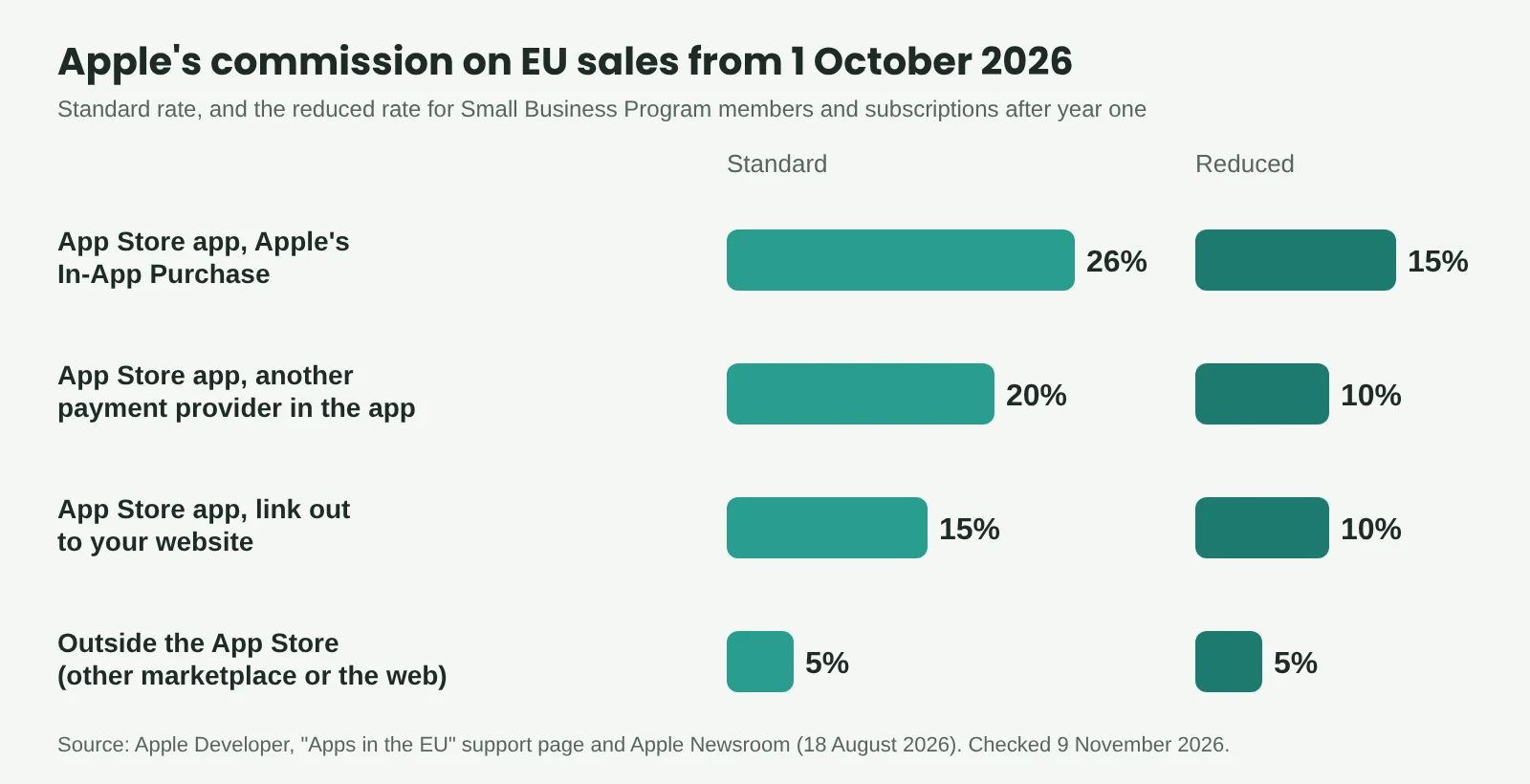
The rates are not added together. For an App Store app, the Core Technology Commission is not charged on top of the link-out or payment rates; Apple’s pages scope it to apps distributed outside the App Store. Apple also says its App Store commission rates “apply to the price paid by the customer”.
The Small Business Program is the line most of our clients fall on. According to Apple’s program page, checked on 9 November 2026, you qualify if your proceeds were no more than US$1 million in the previous calendar year, and you stay in it while you remain under that figure.
New choices, with a 12-month commitment
Two practical changes stand out. Developers in the EU can now offer Apple’s In-App Purchase alongside another payment option in the same app, which the newsroom post says had not been permitted there before. Apple attaches presentation requirements to how the choice is shown.
And whatever mix you pick, Apple’s support page says you “must maintain those options for 12 months”. Switching on a whim after one bad month is off the table.
There are child-safety rules too. Apps in the Kids category can’t link to websites to complete a sale. Under 18s must pass a parental gate before paying through another provider or a link, and under 13s can’t be sent out of the app to pay at all.
A real-world example: a language school’s subscription
Say you run a small language school in Dublin with an iPhone app that sells a €10-a-month subscription to practice lessons. You’re well under US$1 million a year, so you’ve joined the Small Business Program.
- Through Apple’s In-App Purchase, Apple takes 15%: €1.50 a month for each subscriber.
- With a “Subscribe on our website” link, Apple takes 10% of sales made within 7 days of the tap: €1.00. You also pay your own card processor, and the customer has to leave the app to pay.
If the same school were not in the program, the gap would be wider: €2.60 through In-App Purchase against €1.50 through a link, until each subscriber passes their first year and the reduced rates apply anyway. On a few hundred subscribers, that difference pays for a fair amount of development.
The cheaper route isn’t automatically the better one. Apple’s checkout is one the customer already trusts and never leaves the app. A web checkout gives you more control over the sale, and adds a step to the buying journey. We’d test the link route on new sign-ups before moving everyone over, given the year-long commitment.
Why it matters for your app
The new terms touch you if your app sells something digital: subscriptions, lessons, credits, premium features. Every rate on Apple’s support page is attached to a sale of digital goods or services. A free app with no in-app sales has no rate to apply, and the per-install fee that once hung over popular free apps is gone.
Someone has to accept the new terms. Apple says only the Account Holder on the developer account can agree to the updated License Agreement. If a studio or freelancer set up your account years ago, check that you, not they, hold that role.
If you sell outside the EU too, nothing here changes your rates elsewhere. Neither of Apple’s announcements describes changes outside the EU, and Apple says web distribution of apps is available only there.
A word on what we don’t know. Apple’s pages don’t say how the rates apply to an app that is both on the App Store and on an alternative marketplace, and we haven’t seen independent figures on how many EU customers will actually leave an app to pay. Treat early claims about conversion rates with some suspicion.
The quick takeaway
- Since 1 October 2026, every app sold in the EU is on one set of Apple terms, with rates of 26%, 20%, 15% or 5% depending on how people pay (lower for small businesses).
- Once you choose your payment options, you’re committed to them for 12 months, so decide deliberately.
- The Account Holder on your Apple developer account needs to accept the updated agreement, and only that person can.
Your turn
Open your Apple developer account this week and find two things: who the Account Holder is, and which payment route your app uses for EU customers. If you can’t answer either, that’s the first message to send your developer.
Sources and further reading
Image credits: Banner photo by Bagus Hernawan on Unsplash. Images marked as AI-generated were created with AI (Claude) for iZenesis.